Expert Craftsmanship
13+ years of exterior experience and proven Florida results.

FESG evaluates and repairs Venice, Florida stucco and EIFS by tracing the visible defect back to the existing wall assembly, accessory or opening involved, prior finish work, and the elevation that must be blended afterward. Typical scopes include cracking and impact damage, corrosion at corners or accessories, failed older patches, EIFS layer restoration, opening transitions, lower-wall resurfacing, and larger managed-property exterior repairs.
Builder & Exterior Experience



 Niagara


VENICE EXTERIOR SERVICES
Venice repair work can involve more than a crack in the finish. Rust staining at a corner, a failed patch beside a replacement window, a damaged EIFS profile, or a lower wall exposed to repeated splash can each require a different repair boundary. We identify the existing assembly and visible finish constraints before deciding how much material should actually be opened or refinished.
 STUCCO REPAIR
Repair planning for cracks, chips, failed patches, rust-stained corners or accessories, and visible finish problems with texture and color matching considered from the start.
Rust staining should not simply be painted over, and every crack does not need the same patch. We review whether the condition is limited to the finish or connected to a metal accessory, prior repair, movement joint, opening, or substrate condition, then choose a repair edge that can be finished cleanly.
 EIFS REPAIR
EIFS restoration for dented or soft wall areas, damaged finish layers, altered window and door returns, and shaped bands, reveals, columns, or foam profiles that need more than cosmetic recoating.
We expose only as much of the assembly as the condition warrants, then rebuild the affected insulation or shaped profile, reinforcement, base coat, edge or termination, and final finish in sequence. At openings, the repair is laid out around the jamb, sill, head, sealant joint, and retained exterior rather than treated as an isolated spot.
 PARGING & FOUNDATION FINISHES
Restoration of block, concrete, parged bases, foundation transitions, entry walls, and grade-adjacent finishes where repeated splash, impact, planting beds, or old resurfacing have changed the lower elevation.
At grade, the wall may change from the upper façade to exposed masonry, concrete, parging, or another finish system. We check the substrate, bond, grade clearance, old coating layers, and the junction with the upper wall so the new base finish ends at a deliberate line instead of creating another weak patch edge.
Explore recent projects completed by our team.
PROJECT PROOF
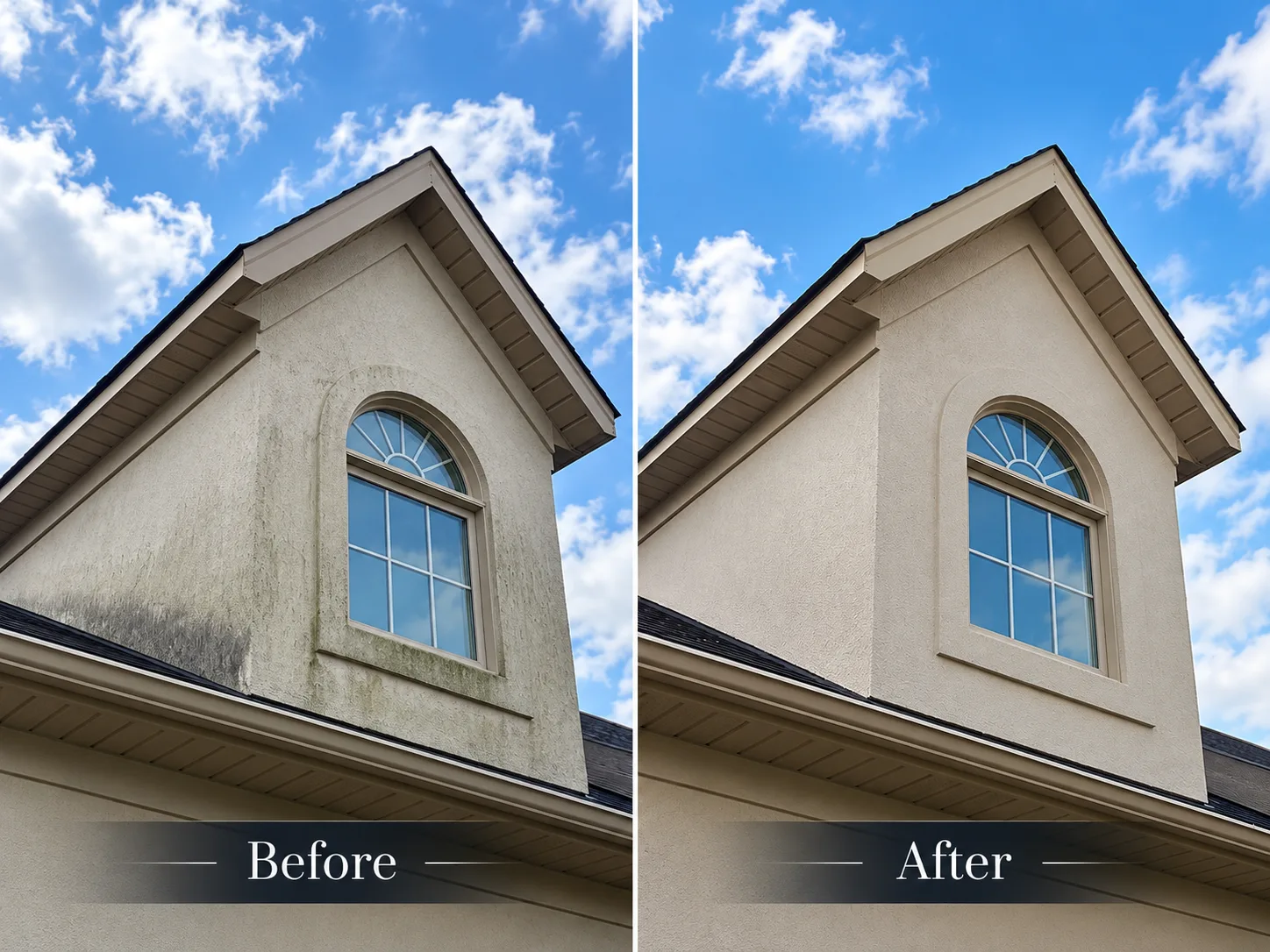
Before & after · Fort Myers
A recent FESG job in Fort Myers. Roof runoff kept this dormer wet, and algae and mold had turned the stucco green and black along the roof line and below the window. It was mostly a repair job: we cleaned the stucco gently, repaired the damaged areas, then renovated the finish so the dormer is one even color again. We see the same algae problem on dormers across Venice and handle it the same way.
How we repair algae and mold on stucco dormers →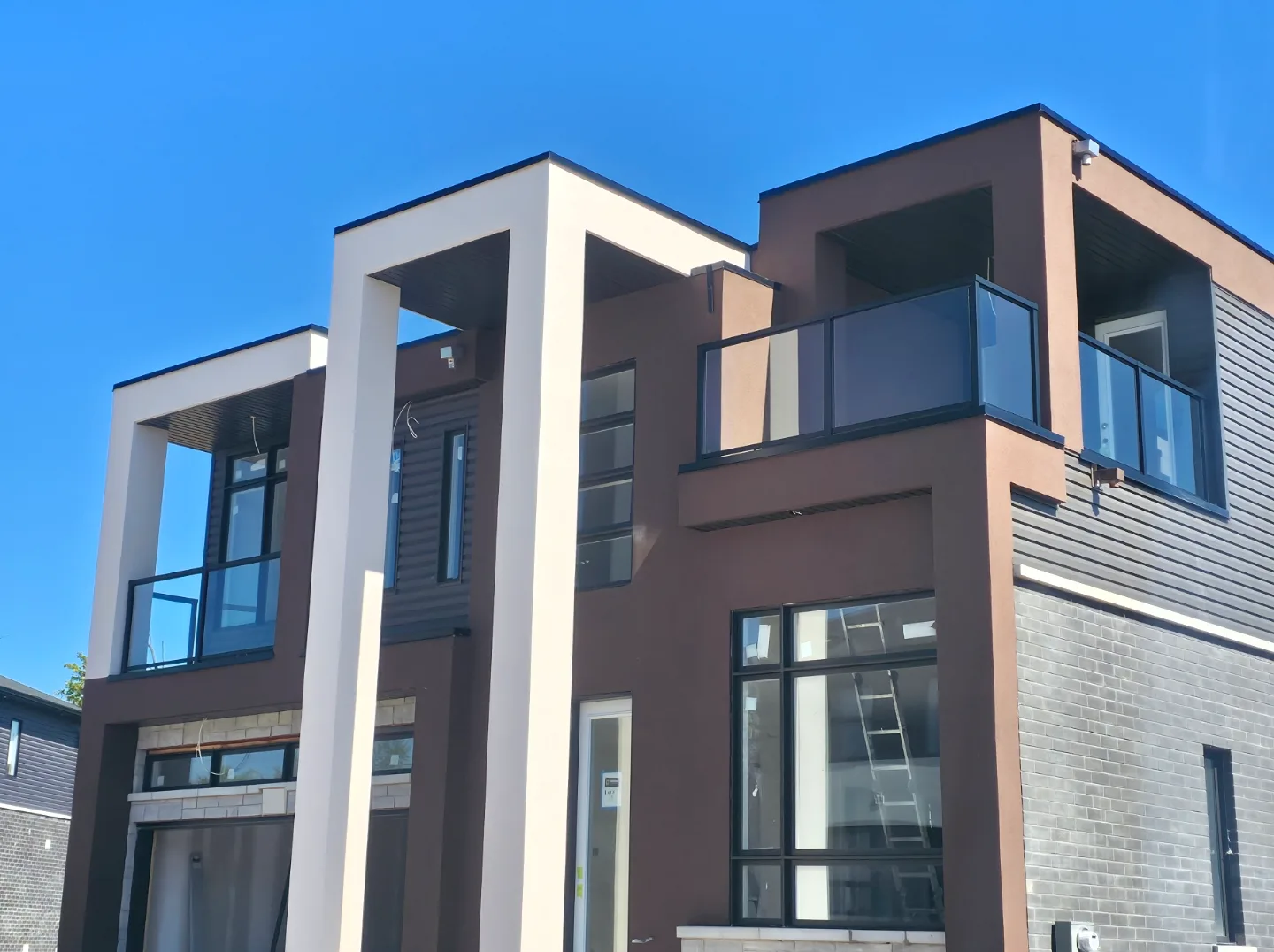
For builders
Much of our work is new construction for home builders. This is one of the homes we finished for Centennial Homes: EIFS columns, balcony surrounds and wall panels in two colors. Builders bring us in for the parts of the elevation that make the house look custom.
Commercial
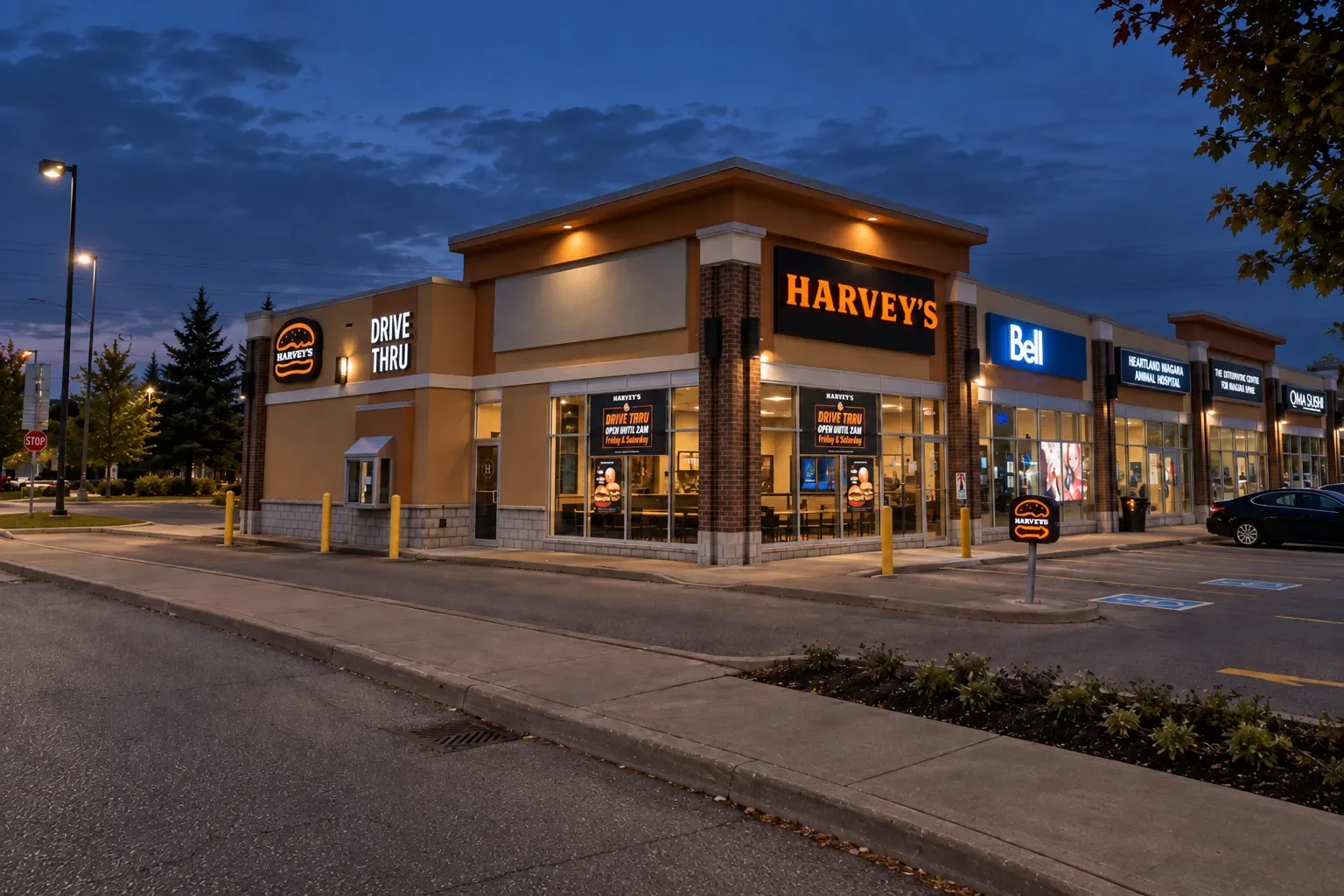
A restaurant pad with a drive-thru, anchoring a strip of storefronts. The EIFS and stucco had to look sharp under signage and night lighting, stay consistent from unit to unit, and get done around open businesses and a working drive-thru lane.
For Venice plazas, storefronts and offices we plan the work by elevation and tenant, so customers can still get in the door.
VENICE REPAIR CONDITIONS
A visible crack, rust mark, old patch, or soft area is only the starting point. Venice repair planning should account for the wall system, accessories, openings, architectural details, repeated exposure, prior coatings, and whether the completed area can blend without creating another obvious repair map.
We review crack pattern, surrounding soundness, impact depth, texture, color, and nearby architectural breaks before deciding whether the work can stay localized or needs a wider finish boundary.
Rust at corners, beads, fasteners, or other accessories can indicate a condition below the visible coating. We identify the affected component and surrounding material before deciding whether the repair is a finish correction or requires removal and rebuilding around the accessory.
Previous repairs can remain structurally sound but visually obvious, or they can fail again at the same edge. We evaluate bond, patch limits, texture, coating age, fading, and natural wall breaks before choosing the next repair boundary.
Replacement windows, new doors, and altered openings bring frames, flashing, sealants, returns, stucco or EIFS, and finish transitions together. We plan the repair around the full opening rather than only the narrow cut line left by the remodel.
If the wall feels soft, exposes foam or reinforced layers, or involves a damaged band or profile, the repair may need to extend through insulation, mesh, base coat, profile geometry, or adjacent terminations before finish is restored.
Ground-level block, concrete, parging, entry walls, and splash zones can have different exposure and repair history from upper elevations. We identify the substrate and a sound repair edge before refinishing.
IDENTIFY THE VENICE WALL SYSTEM
Venice properties can combine cement-based stucco over masonry or framed construction, EIFS/synthetic stucco, architectural foam profiles, painted finishes, parging, and later remodel tie-ins. The existing assembly determines what layers may need removal, how the repair is reinforced, and how openings, accessories, or architectural details should be rebuilt.
Cement-based stucco repair may involve removing unsound material, rebuilding the repair area, matching the surrounding texture, and blending the finished surface. The correct scope depends on the substrate and how far the damage extends.
EIFS is a layered wall system, so repairs may involve insulation, reinforced base coat, mesh, finish coat, and transitions around openings. A surface-only patch is not always enough when deeper layers are affected.
LOCAL PATCH, COMPONENT REPAIR OR WIDER FINISH RESTORATION?
Keep the scope contained when surrounding material is sound, the defect is limited, and the texture and color can transition at a realistic wall or architectural break.
Expand the repair when rusted accessories, window or door interfaces, soft EIFS, damaged profiles, or exposed layers mean the work has to reconnect more than the surface finish.
Use a broader finish boundary when fading, repainting, multiple old patches, architectural-review color requirements, or a prominent elevation would make another spot patch remain visibly pieced together.
VENICE REPAIR ESTIMATE PREP
A wide photo tells us where the damage sits; close-ups show the crack, rust, patch, exposed layer, or damaged profile. Together they help distinguish a local finish repair from an opening, accessory, EIFS, lower-wall, or design-review issue that needs a broader scope.
VENICE STUCCO REPAIR COST FACTORS
A short crack in sound material is a different project from a similar-looking line beside a rusted corner bead, replacement window, soft EIFS area, or controlled-district finish change. We price the actual wall condition and the work needed to rebuild and finish it cleanly.
Surface finish repair differs from work that reaches reinforcement, insulation, lath, substrate, accessory, or architectural profile layers.
Corners, beads, windows, doors, returns, sealant interfaces, and remodel cut lines add detailing beyond flat-wall patching.
Texture, color, fading, repainting, previous patches, sheen, and prominent elevations affect the practical finish boundary.
Upper levels, lanais, landscaping, balconies, narrow side yards, lifts, protection, and occupied areas affect mobilization and production.
City-versus-County jurisdiction, HB 803 qualification, flood-area requirements, and Historic/Venetian Theme district controls can change documentation and finish decisions.
VENICE REPAIR PROJECT TYPES
The same stucco or EIFS materials can require different planning on a single home, a repeated condominium repair program, or a commercial façade. We organize the scope around access, visibility, wall system, finish standard, property coordination, and any permit or architectural-review requirements that apply.
Cracks, rusted corners or accessories, impact damage, old patches, replacement-window or door tie-ins, architectural details, parging, and finish matching on existing homes.
For condominium or managed-property work, we group defects by building and elevation, note repeated accessory/opening conditions, define the finish standard, and plan occupied-area access so management can review one controlled repair program instead of a collection of unrelated patches.
Qualifying commercial restoration can combine EIFS profile repair, stucco openings and terminations, repeated façade defects, finish-control requirements, access planning, and—where the address triggers it—permit or architectural-review coordination before visible exterior changes are made.
VENICE COVERAGE
This page is dedicated to Venice, Florida stucco and EIFS repair. FESG also reviews qualifying South Venice, Nokomis, and nearby Sarasota County repair scopes based on exact address, wall system, project size, access, repair pattern, and scheduling. The address is important because City of Venice and Sarasota County use separate permitting systems.
VENICE PERMIT + ARCHITECTURAL CONTEXT
The City of Venice says a building permit is generally required when an owner or authorized agent intends to construct, enlarge, alter, or repair a building or structure. Effective July 1, 2026, the City's HB 803 policy allows only qualifying single-family residential work valued under $7,500 to request a permit exemption when every listed condition is satisfied: the work must be non-structural, must not affect life-safety systems, must not include regulated trades unless separately exempt, must not be in a flood hazard area where a permit is required, and cannot be split into separate scopes to avoid permitting. Documentation must be submitted and the Building Division decides whether the request qualifies. Separately, the City states that exterior alterations within Historic or Venetian Theme districts must comply with the architectural-review district regulations and color changes must comply with the applicable color requirements. Properties outside City limits can fall under Sarasota County's separate Building Division, so we use the exact address before applying City or County guidance.
VENICE FAQ
Often, yes, when the surrounding material is sound and there is a practical finish boundary. We review crack pattern, wall system, old patches, texture, color, repainting, and how visible the area is before deciding whether a localized repair is likely to finish cleanly.
Rust staining can involve a metal corner, bead, fastener, or another concealed accessory, but the visible stain alone does not prove the exact cause or repair depth. We inspect the condition and surrounding material before deciding whether the work is a surface correction or needs removal and rebuilding around the affected component.
EIFS is a layered exterior system that can include insulation, reinforced base coat, mesh, acrylic finish, and shaped architectural details. Traditional cement stucco uses a different assembly. A similar-looking defect can therefore require different removal, reinforcement, and rebuilding depending on the wall system.
Yes. We review the entire opening condition, including retained wall material, returns, frame transitions, sealant interfaces, flashing context, trim, texture, and color. The goal is to reconnect the exterior system intentionally instead of leaving a narrow visible patch around the opening.
The City says permits are generally required for building alteration and repair. Its HB 803 policy, effective July 1, 2026, allows qualifying single-family residential work under $7,500 to request an exemption only when all listed criteria are satisfied and the Building Division approves the request. It is not an automatic dollar-threshold exemption.
The City policy says the property must be single-family residential, total work value must be under $7,500, the work must be non-structural and not affect life-safety systems, regulated trades cannot be included unless separately exempt, the work cannot be in a flood hazard area where a permit is required, and the project cannot be split to avoid permitting. Documentation must be submitted for City review.
They can affect an exterior alteration or color change when the property is within one of those City districts. Venice states that exterior alterations in Historic or Venetian Theme districts must comply with architectural-review regulations and that color changes must follow the applicable color requirements. The property location and proposed visible change should be checked before assuming only the building-permit question matters.
Send one full-wall photo, close-ups of the damage, any rust staining or damaged accessories, nearby windows or doors, architectural bands or details, lower-wall transitions, and any exposed layers. Include the address, approximate dimensions, number of stories, access constraints, and known repair or repainting history.
Yes, for qualifying scopes. Larger work is reviewed around repeated conditions, access, occupied areas, finish consistency, documentation, project scheduling, and any permit or architectural-review requirements that affect how the work should be staged.
VENICE ESTIMATES
Wide photos plus close-ups help us review the wall system, accessory condition, previous patches, openings, architectural details, finish visibility, access, approximate repair area, and whether the request appears localized or needs a broader on-site review.
LOCATION
Use the Venice service-area map for the general location, then include the exact property address with the repair photos. The address helps distinguish City of Venice from Sarasota County permitting and identifies whether Historic or Venetian Theme district requirements may apply to an exterior alteration or color change.
We’re accepting estimate requests for upcoming Venice stucco repair, EIFS restoration, rust and corner repair, opening tie-ins, finish matching, parging, multifamily, and qualifying commercial exterior repair projects.
Free on-site estimate
All dates are booked. No openings are currently available.
Request received
Your preferred estimate time was sent to FESG. We’ll contact you to confirm the appointment.